In the post-pandemic era, consumer demand for "immune support" has shifted from short-term panic to long-term health maintenance, driving market growth for functional fungi like Reishi, Antrodia cinnamomea, Cordyceps, and Lion’s Mane. However, product developers (B2B) and end-consumers (B2C) alike often face the following questions:
- "Which has stronger bioactivity: mycelium or fruiting bodies?"
- "Why are some raw materials cheap while others are highly-priced?"
- "Does a high polysaccharide content guarantee product efficacy?"
These aren't just marketing catchphrases; they involve biological definitions, production processes, and product efficacy positioning. This article breaks down the science behind these terms from an industry perspective to help you make the most precise decisions.
Quick Guide: 30-Second Takeaways
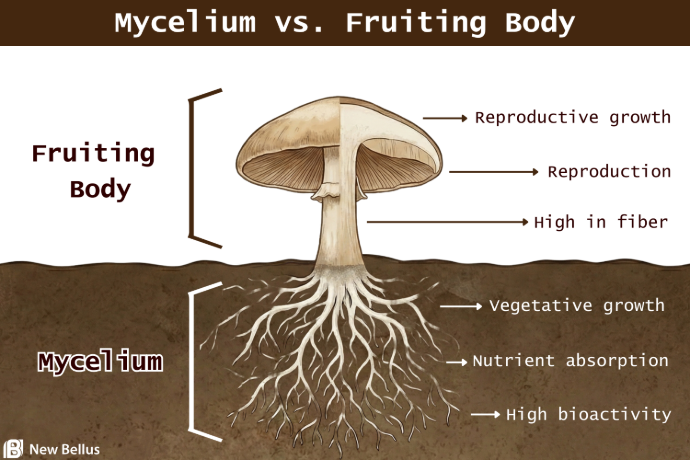
- Anatomical Differences: Mycelium is responsible for nutrient absorption and metabolism, rich in bioactive compounds. The Fruiting Body is the reproductive structure, containing higher fiber.
- Production Technology: High-end B2B raw materials often utilize Patented Submerged Fermentation to produce mycelium, ensuring no contamination, stable quality, and controllable active ingredients.
- The Polysaccharide Myth: Total content isn't the only standard. β-Glucan (Beta-Glucan) is the key immunomodulatory component; excessive starch (α-Glucan) provides no functional benefits.
- Sourcing Guide: For high water solubility and functional beverages, choose "Mycelium." For a whole-food mouthfeel and dietary fiber, choose "Fruiting Body."
1. Mycelium vs. Fruiting Body: Biological Definitions and Differences
First, we must clarify the life cycle of mushrooms. In biological taxonomy, mushrooms belong to the "Fungi" kingdom, not plants.
Mycelium: The Vegetative Growth Stage
- Definition: The vegetative stage of fungi. Composed of thread-like hyphae, it decomposes substrates and absorbs nutrients.
- B2B Value: This stage exhibits the most vigorous vitality, synthesizing massive amounts of secondary metabolites (e.g., enzymes, polysaccharides).
- Production Advantage: Modern biotech companies (like New Bellus) utilize Patented Submerged Fermentation in closed, sterile bioreactors. Advantages include zero heavy metal/pesticide residue, batch-to-batch consistency, and the ability to induce high concentrations of active compounds.
Fruiting Body: The Reproductive Growth Stage
- Definition: The reproductive stage (the edible mushroom we typically see). A fleshy structure grown to propagate and disperse spores.
- B2B Value: Rich in crude fiber, chitin, and trace elements.
- Production Characteristics: Mostly cultivated via "solid-state cultivation" (space bags, wood logs). While it meets consumer perception of "whole foods," it is susceptible to climate changes, has long production cycles, and often struggles with quality consistency.
Mycelium vs. Fruiting Body: A Sourcing Decision Guide |
||
|
Comparison Point |
Mycelium (Patented Submerged Fermentation) |
Fruiting Body (Solid-State Cultivation) |
| Growth Stage | Vegetative Growth (Vigorous absorption & metabolism) | Reproductive Growth (Complete reproductive structure) |
|
Production Environment | Cleanrooms, Bioreactors (Industrial standards) | Farmhouses, Greenhouses, Outdoors (Agricultural) |
|
Safety | Extremely High (Free from stray bacteria, pesticides, and heavy metals) | Variable (Requires strict testing for environmental contamination) |
| Composition Profile | High water solubility, high concentration of secondary metabolites | High fiber content, more insoluble components |
| Supply Chain | Stable (Unaffected by weather, punctual delivery) | Volatile (Affected by climate, unstable consistency) |
Further Reading: Want to dive deeper into the costs and benefits of the two production technologies?
→
[Industry Feature] Comparing Mushroom Production Technologies
2. What are Polysaccharides? Debunking the "Content" and "Structure" Myths
When reviewing a Certificate of Analysis (COA), please note: "Structure" is far more important than "Total Amount."
α-Glucan vs. β-Glucan
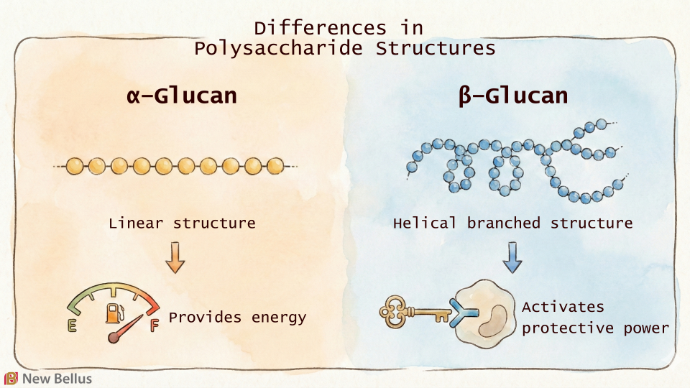
- α-Glucan: Primarily starch. Human digestive enzymes break it down into glucose for energy. It offers minimal immunomodulatory benefits.
- β-Glucan: The true "functional polysaccharide." Indigestible by humans, it reaches the intestines intact to bind with immune cells (like macrophages) and activate defense mechanisms.
Why choose "Mushroom-derived" β-Glucan?
The structure from different sources determines their "characteristics":
- Oat/Barley: Linear structure; excellent for regulating blood lipids and sugar (metabolic health).
- Yeast: Long-branched structure; good immune activity but poor water solubility, prone to precipitation.
- Mushrooms (New Bellus Technology): Features a unique triple-helix structure with short side chains (1,3/1,6 linkages). It offers high immune affinity and, through special processing, boasts high water solubility, completely solving the precipitation issue.
3. Four Core Values: B2B Product Development Selling Points
3-1. General Core Values: Why do you need Mushroom β-Glucan?
Selecting high-quality mushroom polysaccharides (β-Glucan) can bring the following four major scientific claims to your product:

1.Targeted Immune Support
As an immune modulator, it "trains" immune cells to remain alert.

2.Premium Prebiotic for Gut Microbiota
It can be utilized by beneficial gut bacteria to produce Short-Chain Fatty Acids (SCFAs).

3.Metabolic Function Support
Regulates physiological functions through special bioactivity.

4.Mucosal Health Protection
Promotes mucin secretion and strengthens intestinal tight junctions, reducing inflammatory responses.
Further Reading: How to choose the molecular weight and branching ratio?
→What Are Polysaccharides? How to Choose β‑Glucan — A One‑Stop Look at Sources, Molecular Weight, and Branching Ratio
3-2. Differentiating with "Strain-Specific Functions"
Although β-Glucan provides a foundational framework for immune modulation, the mycelium of different strains contains distinct secondary metabolites. R&D professionals can select the appropriate strain combinations based on the targeted functional positioning of their products:
4. Application Scenarios: Choosing the Right Raw Material
Depending on the format of the end product, we recommend:
Functional Beverages & Drops → Choose Beta-Glucan
Advantage: Fully water-soluble, clear, transparent, and smooth-tasting with no off-odors.
Meal Replacements, Capsules, Tablets → Choose Liquid Fermented Mycelium
Advantage: Patented Submerged Fermentation technology precisely controls active ingredient concentrations, offering the standard for high-quality, high-safety functional products.
5. Conclusion
From the vegetative mycelium to the reproductive fruiting body, every choice dictates the final value of your product. New Bellus is dedicated to providing high-purity, standardized, and highly safe functional mushroom raw materials through Patented Submerged Fermentation, helping our B2B partners craft highly competitive market products.
FAQ
Q1: Is it better to consume mycelium or the fruiting body?
A: From the perspective of developing "functional health supplements," we highly recommend "liquid fermented mycelium." Because liquid fermentation (submerged fermentation) is conducted in a sterile environment, it guarantees no pesticide or heavy metal contamination. Furthermore, technological regulation allows for the production of high concentrations of active metabolites (such as unique active compounds and β-Glucan). The quality and efficacy are much more stable and safer compared to fruiting bodies, which are easily affected by climate, growing environment, and cultivation time.
Q2: Why do you emphasize β-Glucan instead of total polysaccharides?
A: Because "total polysaccharides" may include large amounts of ineffective starch (α-Glucan). Only by quantitatively testing for β-Glucan can you ensure the raw material possesses genuine immunomodulatory and physiological benefits.
Q3: What is the difference between β-Glucan from different sources (Oats vs. Mushrooms)?
A: Oat-derived β-Glucan is primarily used for cholesterol reduction; mushroom-derived β-Glucan, due to its unique triple-helix structure, specializes in immune modulation and constitution adjustment.

B2B Supplement R&D Hub: Unlocking Functional Mushrooms
How should mycelium and fruiting body ingredients be evaluated? Explore our “B2B Supplement R&D Hub: Unlocking Functional Mushrooms” video series for insights into ingredient specifications, marker compounds, strain characteristics, and Patented Submerged Fermentation—supporting more informed functional mushroom ingredient selection.