Healthy aging is about more than living longer. It is also about maintaining physical function and quality of life as we grow older. From muscles and bones to cognition-related performance, these seemingly distinct areas are all essential parts of healthy aging research.
New Bellus recently published a new study on Lacticaseibacillus paracasei NB23 in the international academic journal Foods in October 2026.
Building on earlier research into exercise performance, this study extends the investigation to a naturally aged animal model, examining spatial learning, muscle strength, endurance and a range of physiological measures to explore NB23 across multiple domains of research.
From Exercise Performance to Healthy Aging: The Next Step in NB23 Research
New Bellus has previously studied NB23 in relation to exercise performance and associated physiological measures. This study shifts the focus to naturally aged mice, examining the same strain from different perspectives in an aging model.
Why does this research matter?
Healthy aging involves more than a single function. As we age, physical activity, muscle and bone status, and cognition-related performance can all change to varying degrees. Understanding aging more fully requires looking beyond any one measure.
The study therefore used a 12-week trial in naturally aged animals to evaluate both live and heat-treated NB23 through behavioral tests, tissue analyses, and physiological and biochemical measures.
This is one of the study’s distinguishing features: rather than focusing on a single test result, it uses multiple measures to explore the same strain across different domains in a naturally aged model.
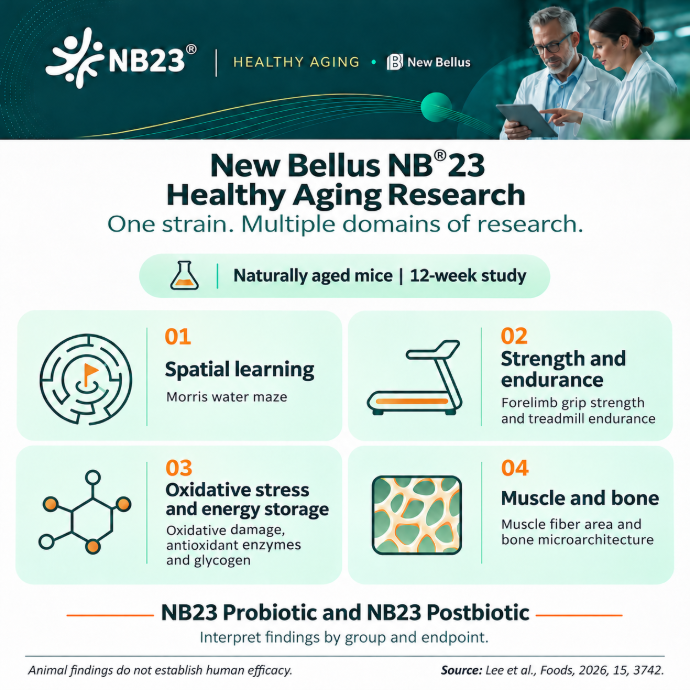
From Learning Performance to Physical Activity: Findings Across Different Research Domains
Spatial Learning: Observing Aging-Related Changes Through Behavioral Testing
Cognition-related performance is an important topic in healthy aging research, and spatial learning is a commonly assessed outcome in animal studies.
This study used the Morris water maze to evaluate how well mice learned to find a hidden platform.
Compared with the naturally aged control group, mice in the high-dose live NB23 and heat-treated NB23 groups took 51.7% and 55.6% less time, respectively, on average to find the platform. They also swam shorter distances, indicating better performance in the spatial learning test.
Compared with earlier work focused mainly on exercise performance, the spatial learning test extends NB23 research to cognition-related behavior, making it one of the notable new findings of this study.
Strength and Endurance: Two Perspectives on Physical Performance
Maintaining physical function is an important part of healthy aging. Although muscle strength and endurance are related, they reflect different aspects of physical performance.
In this study, mice in the live and heat-treated NB23 groups ran longer in the treadmill endurance test than those in the aged control group. Time to exhaustion was 83.7% longer in the high-dose live NB23 group and 95.8% longer in the heat-treated NB23 group.
Forelimb grip strength was also higher in these two groups, exceeding that of the naturally aged control group by 24.4% and 25.7%, respectively.
These findings in endurance and muscle strength tests in naturally aged mice extend earlier exercise-focused NB23 research to aging-related physical performance.
From Oxidative Stress to Energy Storage: A Closer Look at Physiological Changes
Beyond visible physical performance, aging also involves physiological changes that are not readily observable.
For example, oxidative stress is closely linked to cellular physiology, while glycogen is an important form of energy storage in the body.
Compared with the naturally aged control group, mice in the live and heat-treated NB23 groups had lower levels of certain markers of oxidative damage in the brain and higher activities of several antioxidant enzymes in the liver. Liver glycogen content was higher in all NB23 treatment groups, while muscle glycogen content was also higher in the high-dose live NB23 and heat-treated NB23 groups.
Running and grip strength tests reflect physical performance, while antioxidant enzyme and glycogen analyses provide a closer look at the physiological status of these mice. This is why the study examines more than exercise performance alone.
Muscle and Bone: Exploring Healthy Aging at the Tissue Level
Muscles and bones provide the foundation for physical activity and are two areas of interest in healthy aging research.
Muscle tissue analysis showed that gastrocnemius muscle fiber cross-sectional area was larger in the live and heat-treated NB23 groups than in the naturally aged control group.
For bone, micro-computed tomography was used to analyze femoral microarchitecture. Some trabecular parameters differed among groups, and the measured bone mineral density in the heat-treated NB23 group was higher than in the aged control group.
Alongside strength and endurance testing, muscle and bone tissue analyses offer another perspective on the study findings. The results for certain bone measures in the heat-treated NB23 group, in particular, identify an area of interest for further research.
One Strain, Different Preparations: Similar Trends Across Research Measures
In addition to its multidomain design, another notable feature of this study is its inclusion of both live and heat-treated NB23.
Probiotic research has traditionally focused on live microorganisms. In recent years, heat-treated microbial preparations have also attracted growing interest in nutritional science.
Despite differences in preparation, the live and heat-treated NB23 groups showed similar directional trends across several measures, including spatial learning, exercise endurance, and certain physiological and biochemical outcomes.
The study highlights not only the findings for live NB23, but also similar observations for heat-treated NB23 in some tests. This opens up further discussion of research on different preparations of the same strain.
However, similar trends do not establish that the two preparations share the same mechanisms of action or are equivalent. Further research is needed to clarify their respective characteristics.
From Exercise Research to Natural Aging: NB23 Research Continues to Expand
For New Bellus, a key aspect of this study is the extension of NB23 research from exercise performance to a naturally aged model.
Alongside continued investigation of muscle strength and endurance, the study adds observations of spatial learning and muscle and bone tissues, broadening our understanding of NB23.
Another finding of interest is that live and heat-treated NB23 showed similar directional trends across multiple tests. This provides additional avenues to explore in future research on heat-treated NB23.
The research value of a strain lies not only in the results of an individual experiment, but also in what each study adds to our understanding. This publication represents another important step in the ongoing NB23 research program.
Reference
Lee, M.-C., et al. (2026). Live and Heat-Treated Lacticaseibacillus paracasei NB23 Improve Selected Functional and Physiological Outcomes in Naturally Aged Mice. Foods, 15(20), 3742.
https://doi.org/10.3390/foods15203742
Study note: This article summarizes published academic research. All percentages above describe differences in test results between specific NB23 treatment groups and the naturally aged control group, rather than changes from before to after the intervention. The findings come from a naturally aged male mouse model and reflect observations under specific experimental conditions. They do not establish effects in humans following consumption and do not serve as a basis for efficacy claims for food products.