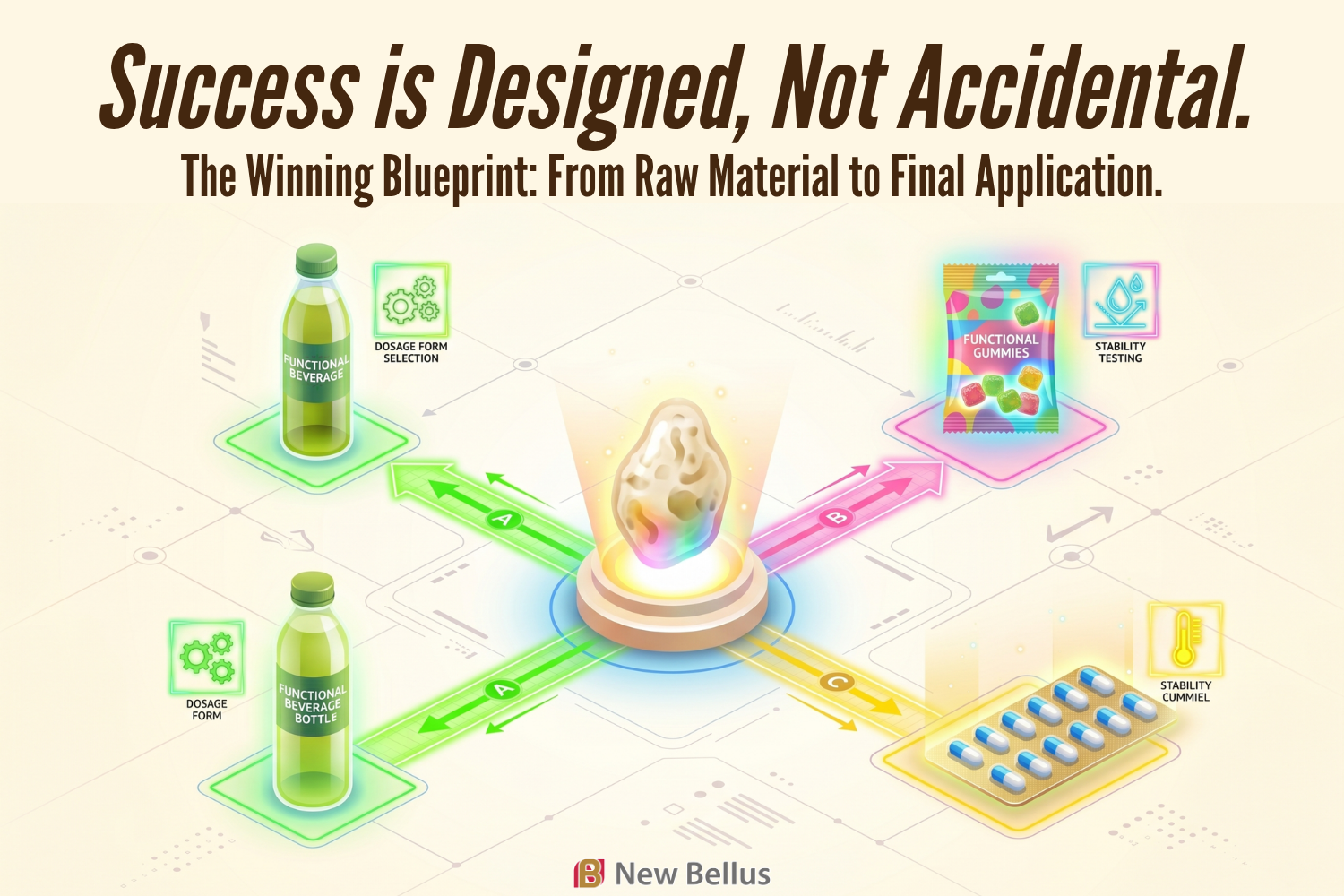
In our industry, we often see a puzzling but very common situation: two brands claim to use similar ingredients, sometimes even the same category of fermentation raw materials, yet their market results are completely different.
One product generates repeat orders, positive user feedback, and long-term sales momentum. Another product, built around what appears to be the “same” ingredient, struggles to stand out in the market. At first glance, people may assume this difference comes from marketing alone. In reality, however, the deeper reason often goes far beyond packaging, channels, or advertising.
From our experience in microbial fermentation, formulation development, and OEM/ODM health food manufacturing, success rarely comes from the ingredient name itself. It comes from whether the ingredient is fully understood, matched with the right application, and supported by the right technical design.
Marketing May Explain the Surface, but Not the Whole Result
When one product performs better than another, the market usually points to visible differences first: packaging, positioning, distribution channels, claims, and storytelling. These factors do matter, especially in competitive health and wellness categories.
But market attention is not the same as market retention.
A product may launch with strong branding and still fail to earn repeat purchases if the actual user experience is inconsistent, the dosage form is inconvenient, the sensory profile is not well accepted, or the expected value is not delivered in real-world use. This is a common frustration for buyers and brand owners: the ingredient looked promising, but the final response stayed average.
The more important question is not simply, “Is this ingredient trending?”
It is, “Is this ingredient truly suitable for this exact application?”
The Real Gap Is Often Application Fit, Not Ingredient Category
In B2B product development, many sourcing decisions begin with ingredient labels: probiotic, postbiotic, fermented botanical, mushroom-derived ingredient, or functional powder. However, an ingredient category is only a starting point. It does not guarantee business success.
Even with similar fermentation raw materials, the final outcome can vary significantly because of hidden but decisive factors.
| Factor |
Why It Matters | Risk When Overlooked |
| Raw material characteristics |
Active compounds, transformation profile, microbial interaction, and stability influence final performance |
Claims appear strong, but user experience feels weak |
| Application scenario | Different product formats and user contexts require different technical behavior | A good ingredient concept fails in the actual product |
| Formula logic | Ingredients must work in a coordinated system | Conflicts reduce efficacy, taste, or consistency |
| Dosage form design | Powders, capsules, gummies, beverages, and sachets all have different formulation demands | Convenience improves, but technical integrity drops |
| Stability and safety control | Shelf life, humidity, temperature, and contamination risk affect trust and product quality | Product feedback becomes inconsistent over time |
This is why two brands can begin with a similar ingredient story but end with very different market performance.
A Good Ingredient Is Not Always a Good Application
This is the deeper issue that the industry still does not discuss enough.
An ingredient may be scientifically validated, commercially popular, and widely promoted in the market, yet still fail to create strong results in a different product setting. That does not always mean the ingredient is ineffective. In many cases, it simply means the application design did not match the ingredient’s nature.
For example, one ingredient may be highly sensitive to heat, moisture, pH conditions, or processing stress. Another may have strong active markers, but poor compatibility with the intended flavor profile or product format. Some fermentation raw materials may offer enhanced transformation value or improved functional potential, but only when those advantages are preserved through formula design, processing, and shelf-life control.
In other words, markets do not reward ingredients in isolation. They reward workable solutions.
For purchasing teams and decision-makers, this distinction is critical. If sourcing decisions are based mainly on trend value, headline claims, or unit cost, it becomes easy to miss the bigger and more expensive question: can this ingredient actually become a stable, scalable, repeatable success in the market?

Why Application Understanding Directly Changes Commercial Results
From our perspective, application understanding is where technical capability and market performance finally connect.
A strong product is not built by stacking features. It is built by creating a coherent path from raw material to end-user experience. In practice, that path depends on four key layers of understanding.
1. Dosage Form Must Match Ingredient Behavior
An ingredient that performs well in powder form may not behave the same way in gummies or beverages. Flowability, hygroscopicity, heat tolerance, dispersibility, and flavor interaction all influence the final product result.
If the dosage form is chosen mainly for market trend appeal, the product may look attractive but lose technical integrity.
2. Formula Logic Must Be Designed, Not Assumed
Many underperforming products are not damaged by one poor ingredient. They fail because the formula lacks internal logic. Functional ingredients can compete with one another, weaken stability, or dilute the intended positioning.
A successful formula requires discipline. Every ingredient should have a defined role, a compatible formulation environment, and a practical reason to be included.
3. Stability Is Part of Real-World Efficacy
At the sourcing stage, teams often focus on potency specifications. But end users experience what remains active at the moment of actual consumption. That is why stability is not a side issue. It is one of the main bridges between technical promise and market credibility.
4. Technical Coordination Builds User Trust
Sensory quality, batch consistency, manufacturability, regulatory readiness, and long-term safety control all shape customer confidence. If these are not aligned, even high-potential fermentation raw materials may fail to create lasting product value.
Industry Trend: Buyers Now Ask What Will Truly Work
Across the health food and functional ingredient market, buyers are becoming more practical. Instead of asking only what is trending, they increasingly ask:
- Can this ingredient survive real formulation conditions?
- Can it support a differentiated product position?
- Can it remain stable during manufacturing and shelf life?
- Can it scale without losing consistency?
- Can it create meaningful user feedback rather than short-term launch excitement?
This trend matters even more in fermentation-related innovation. As more brands enter the market with similar ingredient narratives, true differentiation comes less from ingredient buzzwords and more from application fit, technical execution, and product credibility.
That is why the future of sourcing is not simply about buying materials. It is about selecting materials that can become successful applications.
Success Is Not Accidental
When we compare why Brand A succeeds while Brand B delivers only average results, we rarely find one dramatic reason. More often, we find a chain of informed decisions.
Brand A understood the ingredient more deeply.
Brand A matched it to the right dosage form.
Brand A built compatibility into the formula.
Brand A considered stability early.
Brand A respected the nature of the raw material.
That is why successful application is not luck. It is design.
At NEW BELLUS, this belief shapes how we approach microbial fermentation, formulation development, and OEM/ODM support. With decades of development experience, strain resources, formulation capability, and rigorous process control, we focus not only on ingredient popularity, but on how fermentation raw materials can be translated into stable, application-ready, and commercially viable product solutions.
If you are exploring fermented ingredients, probiotic-related development, or differentiated health product opportunities, you are welcome to learn more about our featured fermentation ingredient solutions here.
If you would like to discuss your next product direction, formulation fit, or commercialization planning, please contact our team.
FAQ
A1: Because business success depends on more than ingredient type. Application fit, dosage form, formula logic, stability, and user experience all influence the final outcome.
A2: Not always. Fermentation raw materials can provide meaningful advantages in certain cases, but their value depends on application design and technical execution.
A3: A common mistake is evaluating ingredients mainly by trend value, claims, or cost, without fully assessing formulation fit, manufacturability, stability, and end-use suitability.
A4: Because powders, capsules, gummies, sachets, and beverages each create different technical conditions. An ingredient that performs well in one format may underperform in another.
A5: They should evaluate ingredients based on application context, compatibility, stability, consumer experience, and production feasibility, not only on specifications.
A6: They should ask whether the ingredient fits the intended dosage form, remains stable through processing and shelf life, supports the desired product position, and can be backed by technical development support.