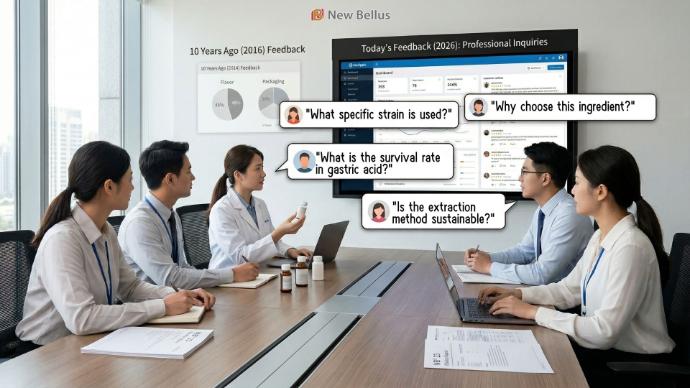
Imagine this scenario: It is Monday morning, and your product development team is sitting in the boardroom reviewing customer feedback on your latest dietary supplement. A decade ago, the comments would have been about the taste or the packaging. Today, however, your inbox is flooded with highly technical questions. Consumers are asking, "What specific strain is used?" "What is the survival rate in gastric acid?" and "Is the extraction method sustainable?"
If you are a procurement officer, a brand owner, or a formulator in the health and wellness industry, you are likely feeling this unprecedented pressure. The days of "fairy dusting"—sprinkling a tiny amount of an ingredient just to claim its presence on the label—are officially over.
We have observed a massive paradigm shift in the market. The fundamental question driving consumer purchasing decisions has evolved from "What is in this product?" to "Why is it in here, how is it made, and does it actually work?" This elevation in consumer intelligence is completely rewriting the rules of ingredient sourcing, formulating, and brand marketing. In this article, we will explore this vital industry shift and explain why your choice of supply partner is no longer just a supply chain decision, but a critical brand-building strategy.
The Era of the Smarter Consumer: They Don't Just Read—They Research
In the past, adding functional ingredients was a simple box-checking exercise. If you wanted to target gut health, you added a generic probiotic. If you wanted an immunity angle, you threw in a mushroom extract. The presence of the ingredient name was the only proof the market required.
Today's consumers are "Nutri-intellectuals." Driven by the democratization of health information through AI search engines, scientific podcasts, and expert influencers, consumers are cross-referencing ingredient claims before they even click "Add to Cart." They no longer accept a generic ingredient list; they demand the story behind it. They want to know the origin of the materials, the environmental impact of the process, and the clinical backing of the specific compounds.
This means that for B2B health brands, the product's efficacy is no longer judged solely by the final output, but by the undeniable quality and traceability of its starting materials.
The Rising Communication Threshold: Why Name-Dropping is Dead
This shift in consumer behavior has significantly raised the communication threshold for brands. A single ingredient name is no longer enough to establish trust.
For example, simply stating that a product contains "mushroom extract" is now seen as evasive. Consumers know enough to ask: Is this the fruiting body or the mycelium? What is the beta-glucan percentage? This is where specifying premium components like high-quality medicinal mushroom mycelium powder becomes a necessity rather than a luxury.
When B2B brands cannot provide transparent, data-backed answers, they lose credibility instantly. Procurement teams are now caught in the crossfire. Marketing needs compelling, verifiable data to sell the product, which means procurement must source ingredients that come with a complete "resume"—including stability testing, clinical backing, and a transparent manufacturing process. The burden of proof has shifted upstream.
The Market’s New Expectations: Explainability, Stability, and Application Rationality
To survive and thrive in this new landscape, product developers and procurement specialists must evaluate ingredients based on a new triad of expectations: Explainability, Stability, and Application Rationality.
- Explainability: Can the ingredient's mechanism of action be easily explained to a layperson? For instance, when utilizing fermented powder, brands must be able to explain why the fermentation process enhances bioavailability compared to unfermented alternatives.
- Stability: A claim is only valid if the ingredient survives the manufacturing process and the product's shelf life. Consumers are increasingly aware of "dead on arrival" supplements.
- Application Rationality: Does the ingredient make logical sense in the chosen delivery format? Putting a heat-sensitive component into a baked functional food lacks application rationality, and educated consumers will spot the flaw.
To better illustrate how these expectations are changing the B2B sourcing landscape, let us look at the evolution of ingredient requirements:
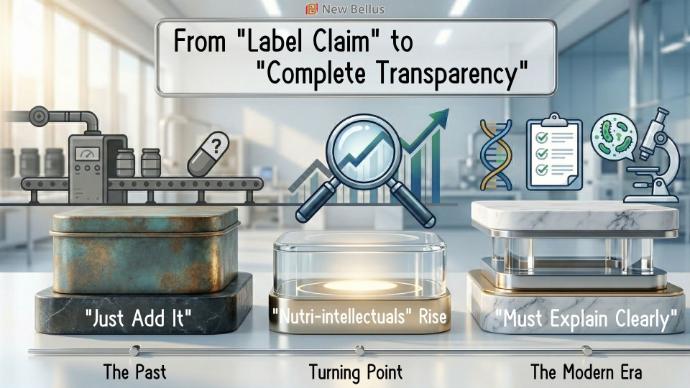
The Evolution of Functional Ingredient Sourcing
| Sourcing Criterion |
Past Era: "Just Add It" |
Modern Era: "Must Explain Clearly" | Business Impact for B2B Brands |
| Identity |
Generic naming (e.g., "Contains Bacteria") |
Specific identification (e.g., Strain-specific identification, exact sourcing) | Builds undeniable consumer trust and allows for premium pricing. |
| Processing | Unknown or irrelevant to marketing | Highlighted as a feature (e.g., specific fermentation raw materials used) | Creates a unique selling proposition (USP) and marketing narrative. |
| Efficacy Proof | Borrowed science (using general research) | Ingredient-specific data and stability reports | Protects brand reputation and ensures high customer retention rates. |
| Format Suitability | Forced into any format | High Application Rationality (matching ingredient stability to product type) | Reduces R&D failure rates and prevents product recalls. |
Table 1: The transition from basic ingredient sourcing to comprehensive ingredient storytelling.
From Theory to Practice: The New Bellus NB® 23 Example
To understand how modern expectations translate into real-world applications, let’s examine a functional ingredient designed for today’s transparency-driven market: New Bellus NB® 23 probiotic.
New Bellus NB® 23 Functional Ingredient Positioning
| Sourcing Criterion |
Modern Expectation |
NB23 Example | Business Impact for B2B Clients |
| Identity |
Strain-specific identification |
Lactobacillus paracasei NB23 (proprietary strain) | Enables premium positioning and differentiation |
| Processing | Transparent production process | Controlled fermentation technology with defined cultivation | Supports strong marketing storytelling |
| Efficacy Proof | Clinical and preclinical validation | Clinical: IGF-1 increase, muscle strength, metabolic improvement; Preclinical: anti-fatigue, endurance | Builds trust and supports claims |
| Functional Positioning | Clear benefit-driven concept | Muscle Health + Metabolic Health + Healthy Aging | Unlocks high-growth categories |
| Format Suitability | Application-aligned | Suitable for capsules, sachets, functional nutrition | Reduces development risk |
| Market Story | Consumer-relevant narrative | “A probiotic for Healthy Aging: muscle, metabolism, vitality” | Improves communication and conversion |
| Differentiation | Unique value | Dual benefit: muscle + metabolic health | Creates strong competitive advantage |
The Changing Role of the Ingredient Supplier: From Vendor to Brand Advocate
Because of these demanding market expectations, the relationship between brand owners and ingredient suppliers must fundamentally change.
In the old model, a supplier’s job ended when the drum of powder was delivered to the manufacturing facility. In the modern model, that is just the beginning. Today, a world-class probiotic ingredient supplier must act as an extension of your R&D and marketing teams.
Suppliers must now provide the scientific scaffolding that supports your brand's claims. This means offering comprehensive dossiers, strain-specific clinical studies, stability data under various temperature and humidity conditions, and even marketing collateral that helps your team translate complex biotechnology into compelling consumer benefits. They don't just supply raw materials; they supply the confidence your marketing team needs to communicate boldly and legally.
Frequently Asked Questions (FAQ)
To help our B2B partners navigate this transition, we have compiled the most common questions we receive from procurement and product development teams:
A: Consumers now demand traceability and proof of efficacy. Therefore, your supplier must be able to provide comprehensive data, origin transparency, and stability reports. If your supplier cannot help you answer consumer questions, they are a liability to your brand.
A: Fermentation is a natural, historically trusted process that modern consumers view favorably. Utilizing high-quality fermentation raw materials allows brands to tell a story of enhanced bioavailability, natural biotransformation, and cleaner labels, which perfectly aligns with the demand for "explainable" ingredients.
A: Consumers are learning that the CFU (Colony Forming Units) count at the time of manufacture doesn't matter if the bacteria die before consumption. Robust stability data proves that the product maintains its promised efficacy through the end of its shelf life, building long-term brand loyalty.
A: By moving away from generic terms. You must communicate the exact part of the mushroom used (e.g., mycelium vs. fruiting body), the extraction method, and the specific active compounds (like beta-glucans or Erinacines A…etc.). Precision builds authority.
A: Look for a partner that offers more than just the material. A true partner provides R&D support, formulation compatibility testing, regulatory assistance, and robust scientific documentation to back up every claim you intend to make on your packaging.
Conclusion: Communication Capability is Your Ultimate Competitive Edge
We are living in an era where the ability to clearly explain an ingredient is just as important as the ingredient itself. An ingredient that cannot be explained, traced, and justified has no long-term market value, no matter how cheap it is to source. The brands that will dominate the next decade of the health and wellness industry are those that embrace transparency and partner with suppliers who can provide the data to back it up.
At New Bellus, we understand that we are not just providing ingredients; we are providing the foundation of your brand's integrity. With decades of pioneering expertise in biotechnology, fermentation, and cultivation, we design our materials to meet the highest thresholds of explainability, stability, and efficacy. We bridge the gap between complex science and consumer trust.
Whether you are looking to elevate your gut health formulations with a traceable probiotic raw material, seeking the powerful, data-backed benefits of mushroom mycelium powder, or aiming to enhance bioavailability with our advanced fermented whole foods powder and premium fermentation raw materials, we have the solutions and the science to support your vision.
Stop settling for suppliers who only give you the materials. Partner with the experts who give you the whole story.
Ready to build products that today's intelligent consumers can truly trust? Contact New Bellus today to discuss how our scientifically backed ingredients can empower your next flagship product.