
Product Differentiation Starts with Ingredient Selection
In the highly competitive health supplement market, similar claims and formula combinations make it increasingly important for brands to establish a distinctive proposition. Beyond positioning and marketing strategy, an ingredient’s scientific evidence, patented technology, and functional characteristics can provide a meaningful foundation for differentiation.
For brands, ingredient selection is not limited to confirming function and specifications. It is also about identifying an ingredient that can support the intended product position, strengthen consumer confidence, and contribute to a competitive market proposition. A differentiated ingredient should offer more than functionality: it should connect market relevance, scientific evidence, and patented technology to a product value that the brand can communicate responsibly.
The following sections examine four dimensions—market needs, scientific research, patented technology, and formulation—to show how brands can identify opportunities for differentiation at the ingredient-selection stage. New Bellus NB®23 is used as a case study to illustrate how strain-specific human research, international journal publication, and Taiwan and Japan invention patents can form part of the evidence base for product differentiation.
1. Identify Opportunities Through Market Needs
When many products already make similar functional claims, the key question is not simply “What product should we make?” but “What value can make it meaningfully different from existing options?” An ingredient’s research background, technical characteristics, and research direction may provide an effective starting point.
Healthy aging is a useful example. Brands targeting middle-aged and older adults may develop concepts related to muscle, bone, metabolism, cognition, or other areas. As Healthy Aging evolves into a broader product-development concept, brands are looking beyond a single function and considering how different needs fit together. An ingredient with relevant research or patented technology can help establish a proposition that differs from familiar market formulas.
After defining the target audience and relevant health needs, brands can ask: Which product areas are already highly homogeneous? Are consumer needs shifting from a single function toward multidimensional health management? Where does meaningful whitespace remain? Does the ingredient have research or a technical background that can support the intended point of differentiation?
When market needs and ingredient characteristics are aligned, an ingredient becomes more than one component in a formula. It can become part of the foundation for product positioning and market communication.
2. Use Scientific Evidence to Build Credibility and Differentiation
In a market crowded with similar functional propositions, scientific research helps brands establish more specific product characteristics. Compared with relying only on general ingredient properties or broad literature, human research conducted on the specific ingredient or strain can provide a more relevant scientific basis for evaluation.
This becomes especially useful when the research direction matches the needs of the intended audience. A brand targeting healthy aging, for example, may consider research related to muscle function, metabolism, and other healthy-aging domains as part of its ingredient assessment. If an ingredient continues to accumulate evidence across several domains, the brand may also explore a broader concept rather than limiting development to a single function.
Selecting an ingredient with a defined research background can strengthen professional credibility and help the brand build a proposition that differs from competing products. Research can also provide a shared reference point for R&D, product planning, and marketing teams, giving product characteristics a clearer scientific basis.
Ingredient research does not mean that the efficacy of a finished formula has been established. Product positioning and external claims must still be assessed against the study design, finished-product conditions, and the regulations of each sales market.
3. Patented Technology as a Source of Technical Differentiation
Scientific evidence can provide a basis for product characteristics, while patents can help explain the R&D outcome and technical features behind an ingredient. For brands, a patent is not merely a reference number; it is information that can be reviewed when evaluating an ingredient’s technical background and differentiation potential.
R&D Differentiation
An ingredient supported by patented technology or defined R&D outcomes may enable brands to move beyond widely used commodity ingredients and build product characteristics around a specific development platform.
Technical Protection and Competitive Barriers
A patent can provide protection within its effective claims and territories. Where the brand has an appropriate license or collaboration arrangement, this may also contribute to a differentiated development position.
Brand Story and Professional Credibility
Patented R&D outcomes can help explain the technical background and distinctive features of an ingredient. This makes the development effort behind a product easier to understand and can reinforce a professional brand image.
The use of a patented ingredient does not automatically give a brand an exclusive market position. The value of a patent depends on its actual claim scope, territory, and collaboration terms. Brands should therefore treat patents as evidence of technical differentiation and R&D capability—not as a blanket claim of market exclusivity.
4. Formulation Turns Ingredient Strengths into Visible Product Value
Research and technical advantages create value only when they are translated into an appropriate product design. Formulation is not simply about whether an ingredient can be added to a product; it also involves aligning the ingredient with the dosage form, method of use, and consumer context. When the intended audience’s habits, a suitable dosage form, and a practical daily-use format are considered together, the ingredient’s strengths become easier for consumers to understand.
Processing stability, specifications, daily serving amount, temperature, moisture, interactions with other ingredients, packaging, and shelf life remain important. These conditions should support the product concept. Brands can work with ingredient suppliers to confirm specifications and define the validation needed for the intended dosage form and product requirements.
Four Criteria for Evaluating Differentiated Ingredients
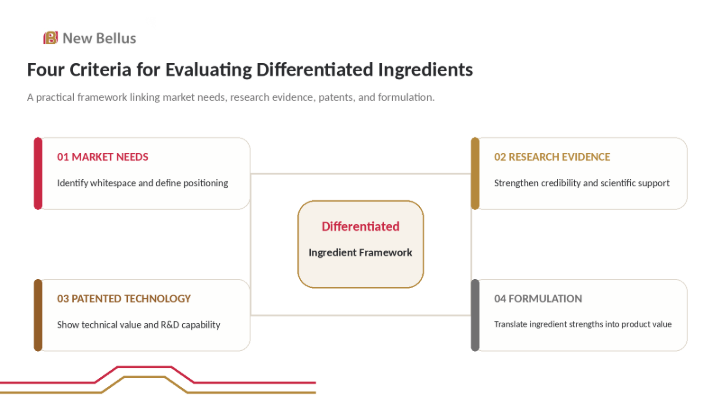
| Evaluation Area |
Questions for the Brand |
How It Supports Differentiation |
| Market Needs |
Which areas are already homogeneous? Which need can the ingredient address? |
Identify opportunities and define product positioning |
| Scientific Evidence | Is there research on the specific ingredient or strain? Does the research align with the intended audience? | Strengthen credibility and scientific support |
| Patented Technology |
Which
R&D outcomes are protected? What differentiation value does the technology
provide?
|
Show
technical characteristics and R&D capability
|
| Formulation | How can the ingredient connect with dosage form, method of use, and consumer context? | Translate ingredient strengths into product value |
From market needs and scientific research to patented technology, NB23 shows how continued R&D investment can build a body of scientific and technical information with differentiation value. For brands, an ingredient with an identified strain, human research, and patented technology can provide a more specific basis for product positioning and create additional opportunities for future innovation.
Case Study: NB23 as an Ingredient Combining Scientific Research and Patented Technology
The four dimensions above ultimately lead to one question: What value can an ingredient create for a brand? NB23 provides a useful case study. Developed through New Bellus’s Functional Probiotic Screening Platform, NB23 has progressed from strain screening and functional studies to human research, international journal publication, and a Japanese invention patent. This continuing body of strain-specific scientific and technical information allows brands to evaluate differentiation beyond a simple comparison of functions.
Responding to Market Change: One Strain for a Multi-domain Healthy Aging Research Strategy
As Healthy Aging shifts from single-function concepts toward multidimensional product development, brands are seeking ingredients that can be evaluated across different healthy-aging needs. NB23 follows this R&D direction by using one identified strain as the core and progressively building scientific information related to multiple Healthy Aging domains.
The publicly described NB23 research portfolio spans muscle and physical performance, metabolism, bone, and cognition. It also includes human clinical research, international journal publication, and patents in Taiwan and Japan. Here, “multi-domain” is not intended as a blanket claim that one strain delivers many functions. It describes a continuing research strategy that explores how one identified strain may relate to different healthy-aging domains and builds a more coherent R&D pathway over time.
For brands, this portfolio offers different points of reference for product planning in different markets, rather than relying only on ingredient stacking to create differentiation. Any finished-product positioning and external communication must still be assessed against the design and evidence level of each study and the regulations of the intended sales market.
Areas observed in NB23-related human research include muscle function and cardiometabolic indicators. These areas may be relevant to the needs considered in healthy-aging product planning. For brands exploring products for middle-aged or older adults, the research background can serve as an ingredient-selection and positioning reference, helping teams consider how the ingredient’s characteristics may connect with the intended audience.
Strain-specific Human Research Provides a Scientific Basis for Evaluation
NB23(Lacticaseibacillus paracasei NB23)has clear strain-identification information, and the Japanese patent document lists the deposit number BCRC911201. Human research on NB23 includes observations related to muscle function and cardiometabolic indicators and has been published in an international journal. For brands, strain-specific research and publication provide more concrete scientific information than a general ingredient description and can support further evaluation of product positioning and differentiation.
Study outcomes, applicable populations, and
communication language must be assessed individually against the original study
design, conditions, and findings. Ingredient research does not mean that a
finished product has obtained an approved efficacy claim.
Japanese Invention Patent: Strengthening the Technical Differentiation of NB23
NB23 has obtained a Japanese invention patent, Japanese Patent No. 7778416 (JP7778416B2). The patent document describes the NB23 strain and related uses. For brands, this patent is a traceable R&D outcome rather than simply an additional reference. When human research, international publication, and the Japanese patent are viewed within the same development pathway, they show the long-term scientific and technical work accumulated around one identified strain.
Research and patents serve different roles. Human research provides scientific evidence, while patents describe R&D outcomes and technical-protection information. When both are considered alongside the target market and product requirements, brands can evaluate not only an ingredient’s intended function but also the development capability and differentiation value behind it.
Patent grant does not constitute regulatory approval of food efficacy or advertising claims. Any finished-product communication must be reviewed against the product conditions, supporting evidence, and applicable market regulations.
Read More about New Bellus NB®23 Awarded Japanese Patent
From Ingredient Strengths to Brand Value
Across market needs, scientific research, and patented technology, NB23 illustrates how sustained R&D can create a body of scientific and technical information with differentiation value.
For brands, selecting an ingredient with an identified strain, human research, and patented technology can provide a more specific basis for product positioning and open additional possibilities for future product innovation and market differentiation.
Three Points to Remember When Selecting a Differentiated Ingredient
- Ingredient selection is an important starting point for product differentiation.
- Strain-specific human research, international publication, and patented technology can provide a more persuasive basis for evaluating product value.
- As market needs evolve, ingredients supported by scientific evidence and defined technical strengths can expand product-development options and contribute to a differentiated market proposition.
FAQ
Start with the target market and product requirements. Market needs define the intended direction, research provides a scientific basis, patents help explain technical differentiation, and formulation translates ingredient strengths into product value.
NB23 has an identified strain, human research information, international journal publication, and a Japanese invention patent. Its publicly described research portfolio continues to explore healthy-aging domains including muscle and physical performance, metabolism, bone, and cognition. These materials allow brands to evaluate the ingredient from market, scientific, and technical perspectives before defining a differentiated product position.
Human research can provide more specific scientific information about an ingredient, while patents can describe R&D outcomes and technical characteristics. When evidence continues to develop across several healthy-aging domains, brands may consider broader product concepts rather than a single-function proposition. These elements must still be aligned with the target market, product design, and actual evidence; external claims remain subject to applicable market regulations.
Prepare the target market, intended audience, product positioning, dosage form, daily serving amount, and storage requirements. These details allow the New Bellus marketing and R&D teams to discuss ingredient characteristics, development options, and any required validation more efficiently.
Plan a Differentiated Product with New Bellus
Functional ingredients with a defined R&D background can help brands build more specific product characteristics. New Bellus develops functional strains and connects research information, ingredient specifications, and product-development requirements to help partners explore differentiated opportunities.
If you are planning a healthy-agingorgeneral nutritional-supplement product,contact the New Bellus team.From market needs and scientific research to patented technology and product application, we can work with you to explore ingredient and development directions that fit your target market and positioning.
Regulatory and Application Notice
This article is provided solely for ingredient and product-development evaluation and does not constitute an efficacy claim for a finished product. Ingredient research does not establish the efficacy of a finished product. Product labeling, promotion, and advertising must be reviewed against the actual formula, supporting evidence, and regulations of the intended sales market. Patent information does not mean that a brand using the ingredient obtains market exclusivity; the actual claim scope and collaboration terms should be confirmed in the relevant documents.